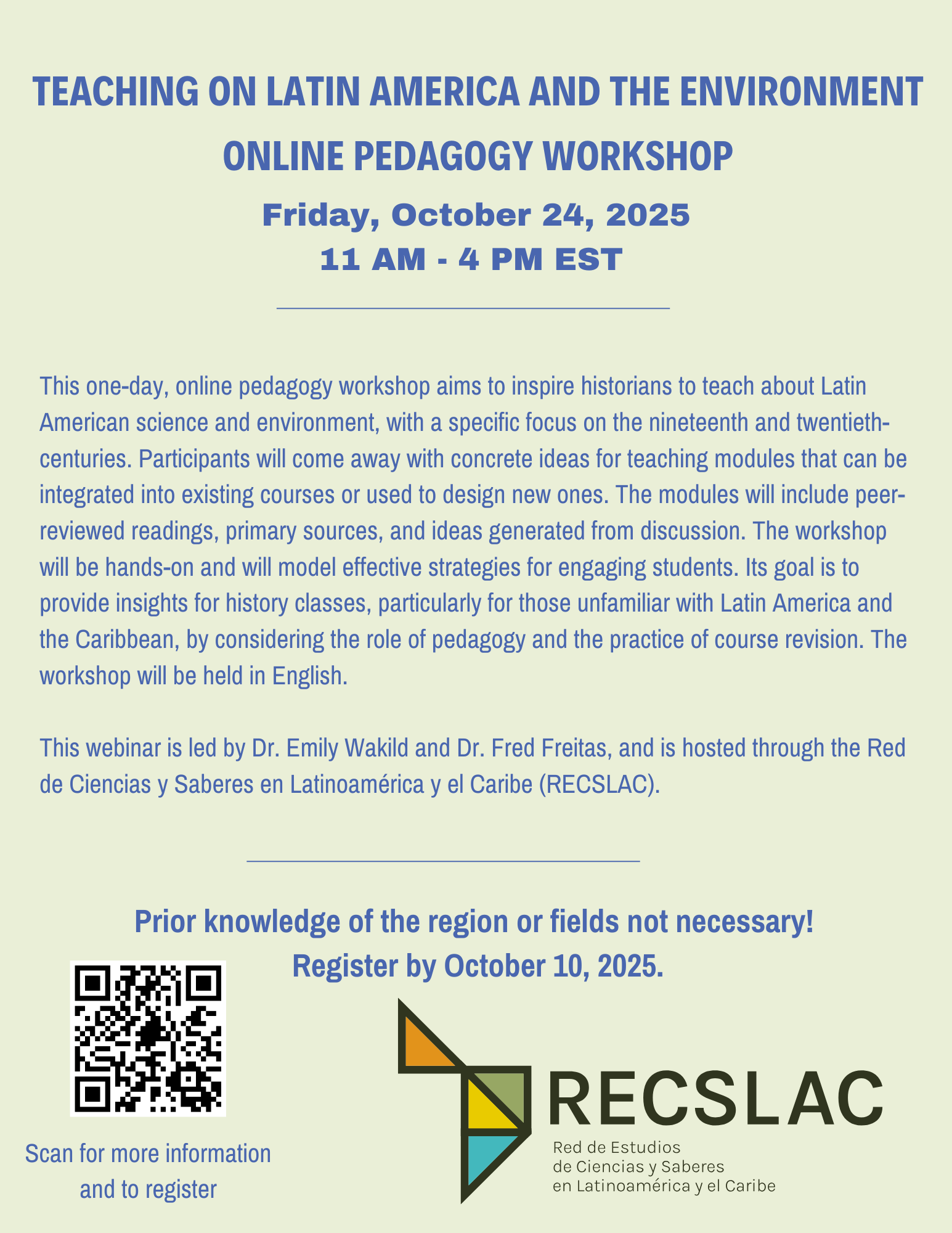
Registration is open for a one-day, online pedagogy workshop on integrating Latin American and Caribbean history of science and environmental history into teaching in adjacent fields.
The workshop aims to inspire historians to teach about Latin American science and environment, with a specific focus on the nineteenth and twentieth-century periods. Participants will come away with concrete ideas for teaching modules that can be integrated into existing courses or used to design new ones. The modules will include peer-reviewed readings, primary sources, and ideas generated from discussion. The workshop will be hands-on and will model effective strategies for engaging students. Its aim is to provide insights for history classes, particularly for those unfamiliar with Latin America and the Caribbean, by considering the role of pedagogy and the practice of course revision. The workshop will be held in English.
We seek participants from diverse backgrounds who are interested in learning more about Latin American history of science and the environment and integrating content on the region into their courses. Prior knowledge of the region or fields is not necessary.
The workshop will be led by Dr. Emily Wakild and Dr. Frederico Freitas.
Space is limited — please register here by October 10, 2025.
Here’s what people are saying about previous RECSLAC Pedagogy Workshops:
“I found many of the activities that we participated in during the workshop very inspiring and I regularly organized similar class activities.”
“I found the resources provided to be extremely useful – the readings and strategies, as well as the more casual conversation about approaches and the big picture of some periods and topics like historiography.”
“This workshop served as an excellent jumping off point to refresh my knowledge in some areas, and to gain knowledge and materials in areas which I was not as familiar. It also inspired me a great deal going into my teaching.”
“[This workshop] inspired new themes and new strategies for discussing environmental history for the present”
“Listening to more experienced colleagues and academics allowed me to do something simple: confirm with greater confidence narratives that I had previously hesitated to present. Sometimes, rather than not knowing about a topic, I worry that I may be making hasty generalizations. Overall, the workshop helped to dispel that fear a little.”
“[The workshop] makes me hopeful that my future career does not need to be determined by the pressures of academic tenure, but rather the joys of teaching.”
Draft Schedule
- Introduction to Latin American and Caribbean Environmental History Teaching
- Round robin room-hopping exercise
- Break
- Lecture–main categories for environmental history in Latin America and the Caribbean
- Small group breakout, primary sources or readings for each category
- Break- work on own or in small groups to revise a syllabus
- Lecture– rubber boom as a case study
- Small group breakout, how integrate this topic into your course
- Break
- Primary source carousel
- Conclusions